EVV vs Time Tracking: What Home Health Agencies Should Separate
Quick-read version · 1 minEVV proves a covered visit happened. Time tracking proves what the agency should review, approve, and pay.
For a home health or home care agency, those two records can overlap without being the same thing. EVV is usually tied to Medicaid visit verification. Payroll time tracking is tied to employee hours, corrections, approvals, exports, and records the office can explain later.
Start with the difference
Electronic visit verification usually answers visit questions:
- Who provided the service?
- Who received the service?
- What service was provided?
- Where did the visit happen?
- When did the visit start and end?
Time tracking answers payroll workflow questions:
- Which hours should be paid?
- Which time cards are missing a clock-in or clock-out?
- Which records need a correction reason?
- Which supervisor approved the final hours?
- What did payroll receive?
- Can the agency find the record later?
The same caregiver clock event may touch both systems. But the agency should know which system is the visit-verification record, which system is the payroll record, and where the handoff happens.
EVV is not automatically payroll-ready
EVV can be the required visit record for Medicaid-covered services. That does not automatically make it the cleanest payroll workflow.
An agency may still need to answer:
- Did the caregiver have travel time between visits?
- Was mileage reviewed separately?
- Was a missed clock-out corrected with a reason?
- Did a supervisor approve the time before payroll?
- Did payroll receive approved hours or a list of unresolved exceptions?
- Can the office find the record months later?
If EVV captures the visit but the office still rebuilds payroll from notes, messages, spreadsheets, or manual edits, the agency has not solved the payroll problem.
If you are choosing software for caregiver time records, read time clock app for home health care.
The location demo below shows the time-tracking side of that split: employee hours with location context, corrections, approvals, and payroll-ready records in one place.
No login required. Opens in one click.
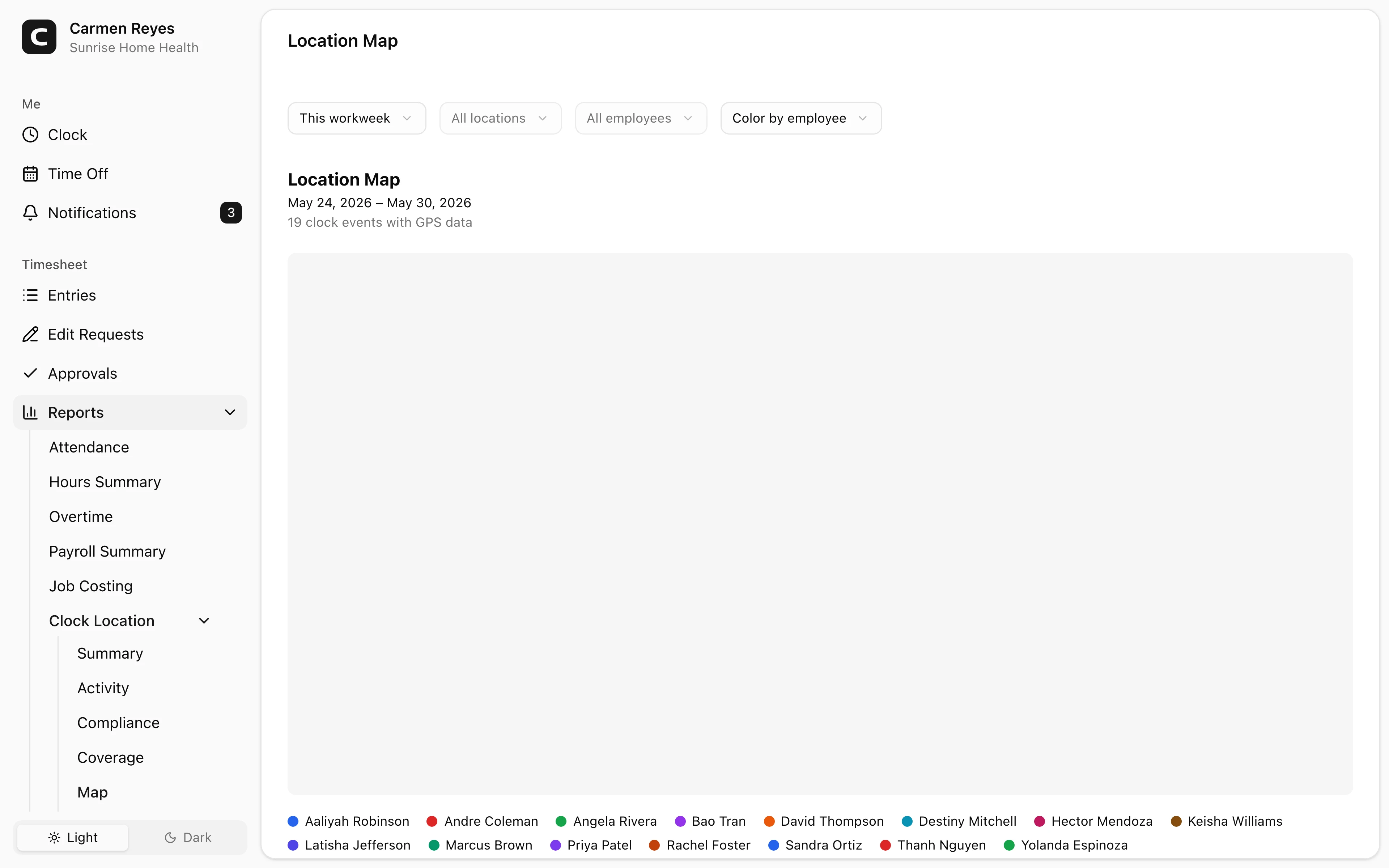
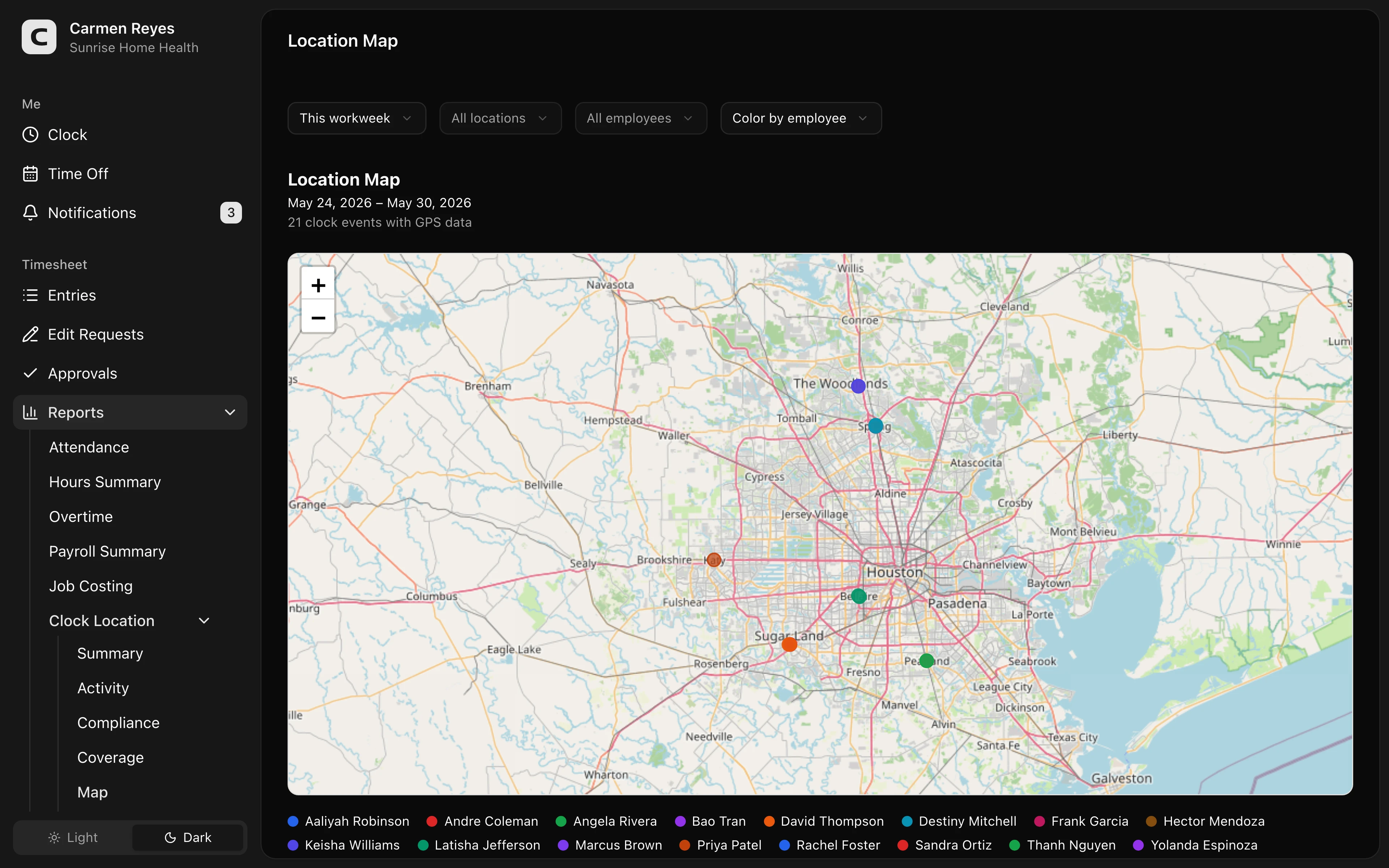 Open a no-login Clockspot demo with time entries, edits, approvals, and payroll-ready records.
The risky setup is a split record no one owns
The agency gets into trouble when visit data, time-card edits, approvals, and payroll totals live in different places and no one owns the final payroll record.
That can happen when:
- EVV holds visit start and end times.
- Scheduling software holds the planned visit.
- A caregiver texts a correction to the office.
- A supervisor approves the visit in one place.
- Payroll receives a different total somewhere else.
When those pieces do not line up, the office has to investigate instead of approve.
Travel time and mileage create the practical gap
Home health work often includes time that sits around the visit record:
- Driving from one client home to another.
- Returning to the office for supplies.
- Calling the office after a visit.
- Charting or finishing required notes.
- Waiting because a visit moved or ran late.
Some of that time may matter for payroll. Some mileage may matter for reimbursement or policy. The answer depends on the facts and the state. But the agency cannot review any of it well if the record only shows completed visits.
For a practical way to keep caregiver travel records clear, read caregiver travel time and mileage. For the pay rules behind travel and mileage, read travel time pay and mileage reimbursement requirements by state.
What a clean two-system workflow looks like
The agency does not need one system to do every job.
It does require clear ownership:
- EVV verifies the covered visit when EVV is required.
- The time clock captures payroll time, location context, missed punches, and corrections.
- Supervisors review exceptions before payroll.
- Approved hours are ready before payroll.
- The agency can find the record later by caregiver, date, client, visit, or location.
If one system handles both EVV and payroll well, that may be enough. If not, use two systems deliberately instead of pretending one incomplete record solves both jobs.
When Clockspot is a good fit
Clockspot is a good fit when the agency already understands its EVV requirement and needs focused time tracking before payroll:
- Employees clock in and out from the field.
- Hours can be reviewed with job or location context.
- The office reviews missed punches, corrections, and location exceptions.
- Supervisors approve final time before payroll.
- Approved hours are ready before payroll.
Clockspot may be a poor fit if the agency needs state-certified EVV, clinical documentation, payer billing, care plans, or patient records in the same product.
If that matches your agency's payroll problem, open the location demo above, then check Clockspot pricing or start a free trial.
FAQ
Is EVV the same as a time clock?
No. EVV verifies certain covered visits. A time clock supports payroll time tracking, missed-punch corrections, approvals, payroll export, and record lookup. Some systems may do both, but the jobs are different.
Can a home health agency use EVV for payroll?
Sometimes, if the EVV system also gives the agency a complete payroll workflow. If the office still has to manage missed punches, travel time, mileage questions, approvals, and payroll exports somewhere else, EVV alone is not enough.
Does Clockspot replace EVV?
No. Clockspot is not positioned as a state-certified EVV platform. It can help with payroll-ready employee time records, location context, corrections, approvals, and exports.
The bottom line
Do not ask one record to do a job it was not built to do.
Use EVV for visit verification when required. Use payroll time tracking to make caregiver hours reviewable, approvable, and explainable before payroll runs.
Keep reading
How to Track Employee Hours for Payroll
Use this payroll-ready time tracking workflow to capture hours, review exceptions, approve edits, and keep records you can explain later.
Time Clock App for Home Health Care: What Agencies Should Look For
Choose a home health care time clock app by checking caregiver visits, EVV fit, GPS, mileage, travel time, approvals, payroll export, and records.
Caregiver Travel Time and Mileage: What Home Health Agencies Should Track
Track caregiver travel time, mileage, visits, location context, corrections, approvals, and payroll-ready records without treating EVV as payroll.
Caregiver Time Tracking Policy: What Home Health Agencies Should Include
Write a caregiver time tracking policy that covers visits, travel time, mileage notes, missed punches, corrections, approvals, and payroll-ready records.
About Clockspot
Clockspot helps small businesses track employee time and keep payroll-ready records. Used in all 50 states since 2007, we focus on getting time and pay right — including the wage-and-hour rules that shape both.
Clockspot helps small businesses keep employee hours, location context, corrections, approvals, and payroll-ready records together. See how Clockspot supports field team time tracking.