How to Track Cleaning Crew Hours by Client or Job
Quick-read version · 1 minCleaning hours are only useful if the office can tell which client or job they belong to.
For a cleaning company, total hours are not always enough. Payroll may need one number, but owners and managers often need to know whether labor went to the right building, account, route, turnover, or one-time job.
Decide what the office actually uses
Before asking cleaners to choose a client, job, route, or location at clock-in, decide what the office will do with that detail after the shift.
Track time by client or job when the detail affects:
- Payroll review.
- Customer billing.
- Job costing.
- Contract profitability.
- Crew accountability.
- Schedule planning.
- Customer questions.
Do not make cleaners choose from a long list the office never reviews. Extra fields create mistakes. Useful fields answer questions the business already has.
If you are choosing software for the whole crew, read time clock app for cleaning companies.
Choose the smallest useful tracking structure
Most cleaning companies can start with one of three structures:
- Client: best when the business mainly needs labor by customer.
- Job or work order: best for one-time projects, construction cleanup, deep cleans, and turnovers.
- Location: best for larger accounts with multiple buildings, floors, departments, or sites.
Some companies need more than one layer. A commercial cleaner might track the client and building. A short-term rental cleaner might track the turnover job. A residential company might only need the customer or route.
The record should answer the office's real questions without making clock-in slow.
The job-costing demo below shows what that detail looks like after time cards are in: approved hours grouped by job, client, or location. Use it to see whether the record would answer the office's questions without making cleaners write a report.
No login required. Opens in one click.
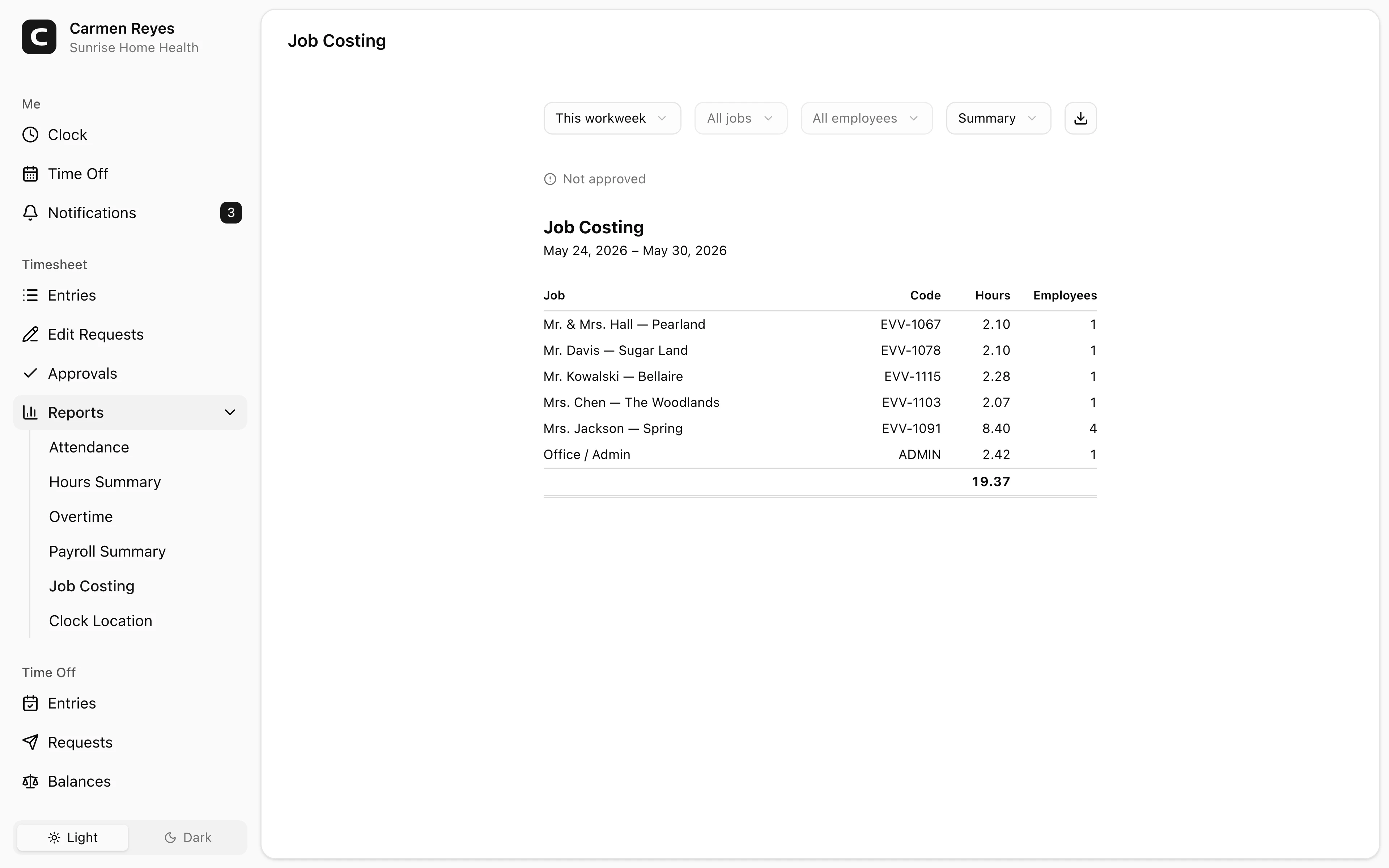
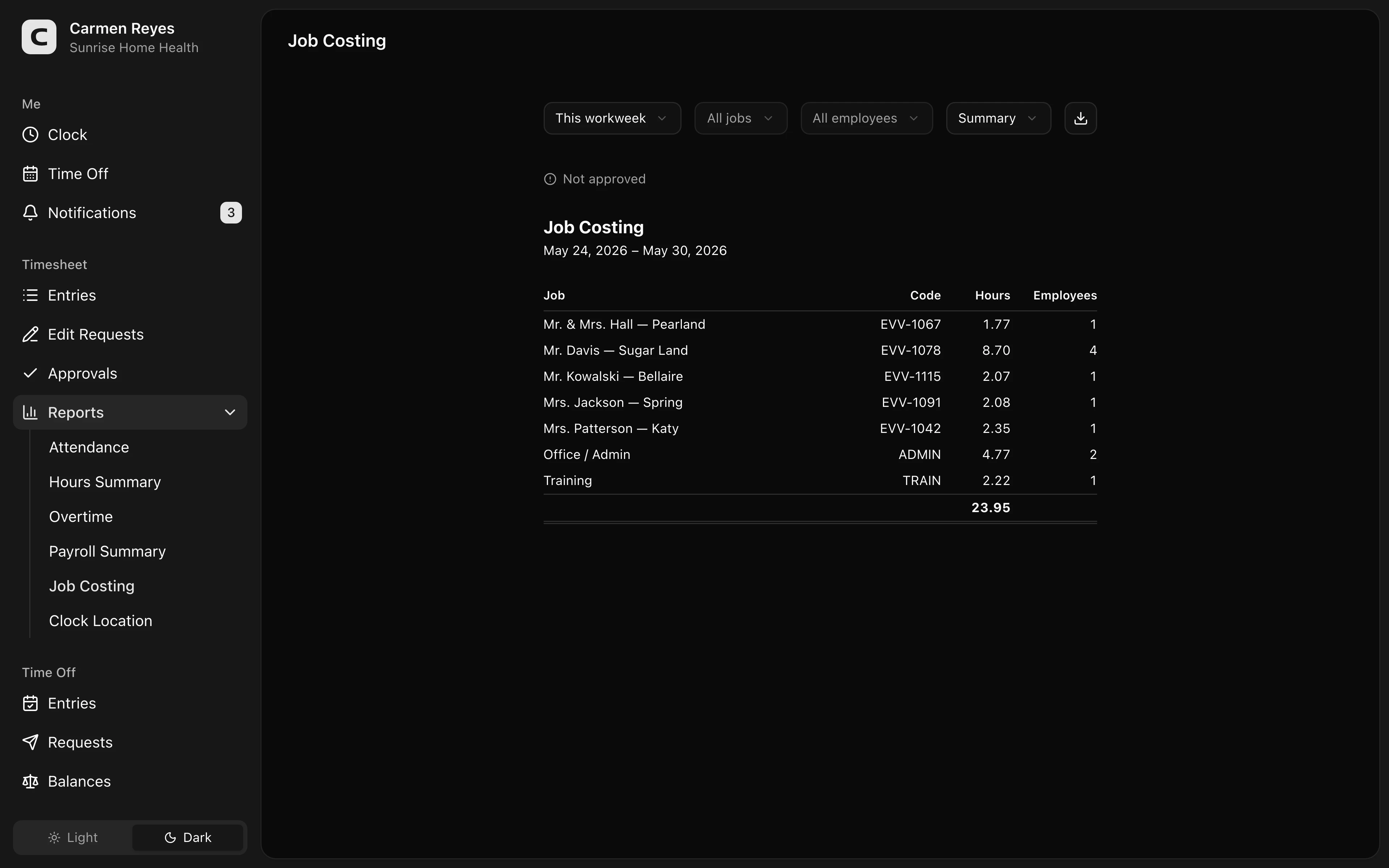 Open a no-login Clockspot demo with time entries, edits, approvals, and payroll-ready records.
Make the choice while the work is happening
Client and job detail is easiest to capture when the cleaner clocks in.
If the office waits until Friday to assign hours, someone has to reconstruct the week from memory, text messages, calendar notes, or manager guesses. That is where payroll and job costing drift apart.
Review exceptions before payroll
Client or job tracking is not only about clock-in.
Managers should review:
- Missing clock-ins or clock-outs.
- Time assigned to the wrong client.
- Work that ran much longer than expected.
- Crews that moved between jobs without a clear split.
- Manual corrections without reasons.
- Time cards not approved before payroll.
The goal is not to challenge every cleaner. The goal is to catch records that need a second look while the work is still easy to remember.
For the approval workflow, read how to approve employee time cards.
For crews that move between client sites, read cleaning crew travel time between jobs.
For a short policy on choosing the right client, job, or location, start here and adapt the names to your office workflow.
Keep GPS in the right role
GPS can help when cleaners work away from a shared clock, but it should support review instead of replacing judgment.
A location mismatch might mean:
- The cleaner clocked in from the parking lot.
- The building has poor signal.
- The crew stopped for supplies.
- The schedule changed.
- The wrong client was selected.
The useful workflow is to flag the record, ask what happened, correct the client or job if needed, and keep the reason.
For broader GPS guidance, read employee time clock with GPS.
When Clockspot is a good fit
Clockspot is a good fit when a cleaning company needs focused time tracking:
- Cleaners clock in from the field.
- Hours can be reviewed with client, job, location, or cost-code context.
- Managers review missed punches and wrong-job entries.
- Corrections include reasons.
- Approved hours are ready before payroll.
- The business can find old job-time records later.
It may be a poor fit if the company needs booking, dispatch, route optimization, inspections, invoicing, or full cleaning-business management in one product.
If that matches your workflow, open the job-costing demo above, then check Clockspot pricing or start a free trial.
FAQ
Should cleaning companies track time by client?
Yes, when client-level hours affect billing, payroll review, job costing, customer questions, or schedule planning. If the company never uses client-level detail, keep the clock-in simpler.
Should cleaners choose the job when they clock in?
Usually yes, if the job matters to payroll, billing, or approval. The record is more reliable when the choice happens during the work instead of days later.
Is GPS enough for job costing?
No. GPS can help confirm location context, but it does not always tell the office which client, job, route, or work order the hours belong to. The time record still needs the right assignment and manager review.
The bottom line
Track the smallest amount of detail that makes the record useful.
For cleaning companies, that often means tying hours to the right client, job, or location at clock-in, then reviewing exceptions before payroll closes.
Keep reading
How to Track Employee Hours for Payroll
Use this payroll-ready time tracking workflow to capture hours, review exceptions, approve edits, and keep records you can explain later.
Time Clock App for Cleaning Companies: What to Look For
Choose a cleaning company time clock app by checking GPS, client locations, job codes, crew hours, approvals, payroll export, and labor records.
Cleaning Crew Travel Time Between Jobs: What to Track Before Payroll
Track cleaning crew travel between client sites with job/location context, mileage notes, corrections, approvals, and payroll-ready records.
How to Approve Employee Time Cards Before Payroll
Use this time card approval workflow to review exceptions, confirm corrections, and send payroll hours you can explain later.
About Clockspot
Clockspot helps small businesses track employee time and keep payroll-ready records. Used in all 50 states since 2007, we focus on getting time and pay right — including the wage-and-hour rules that shape both.
Clockspot helps small businesses keep employee hours, job/location context, approvals, and payroll-ready records connected. See how Clockspot tracks cleaning crew hours.