How to Write an Employee Time Tracking Policy
A time tracking policy should answer the questions employees and managers actually face during the week.
When should someone clock in? What if they forget? Who can edit a time card? When are hours final for payroll? If the policy does not answer those questions, the business will make the rules up during payroll.
What the policy should cover
A useful time tracking policy covers six things:
- Who must track time.
- When employees clock in and out.
- How breaks are recorded.
- How missed punches and edits are handled.
- Who reviews and approves time cards.
- How long records are kept after payroll.
Keep the policy short enough that employees and managers can follow it.
This is the policy version of the broader payroll-ready time tracking workflow: capture the right hours, review exceptions before payday, and keep records the business can explain later.
Say who must track time
Start by saying which employees must record hours.
For many small businesses, hourly nonexempt employees must track their time every workday. Salaried exempt employees may not need the same daily punch process, while salaried nonexempt employees still need hours tracked because overtime can apply.
Do not rely on job titles alone. If the classification is unclear, read salaried nonexempt employees.
Define clock-in and clock-out expectations
The policy should say when employees clock in and out:
- Before starting work.
- When stopping work.
- Before and after unpaid meal breaks, if your workflow tracks breaks.
- When changing job, department, or location, if that affects payroll or reporting.
Be specific about off-the-clock work. If employees check messages, prepare equipment, clean up, travel between jobs, or finish tasks after clocking out, the policy should tell them how to record that time. If you need to check when off-the-clock work must be paid, read off-the-clock work by state.
The demo below shows what the policy turns into during the workday: employees create time entries that managers can later review, correct, and approve before payroll. A policy is easier to follow when the workflow makes the expected record visible.
No login required. Opens in one click.
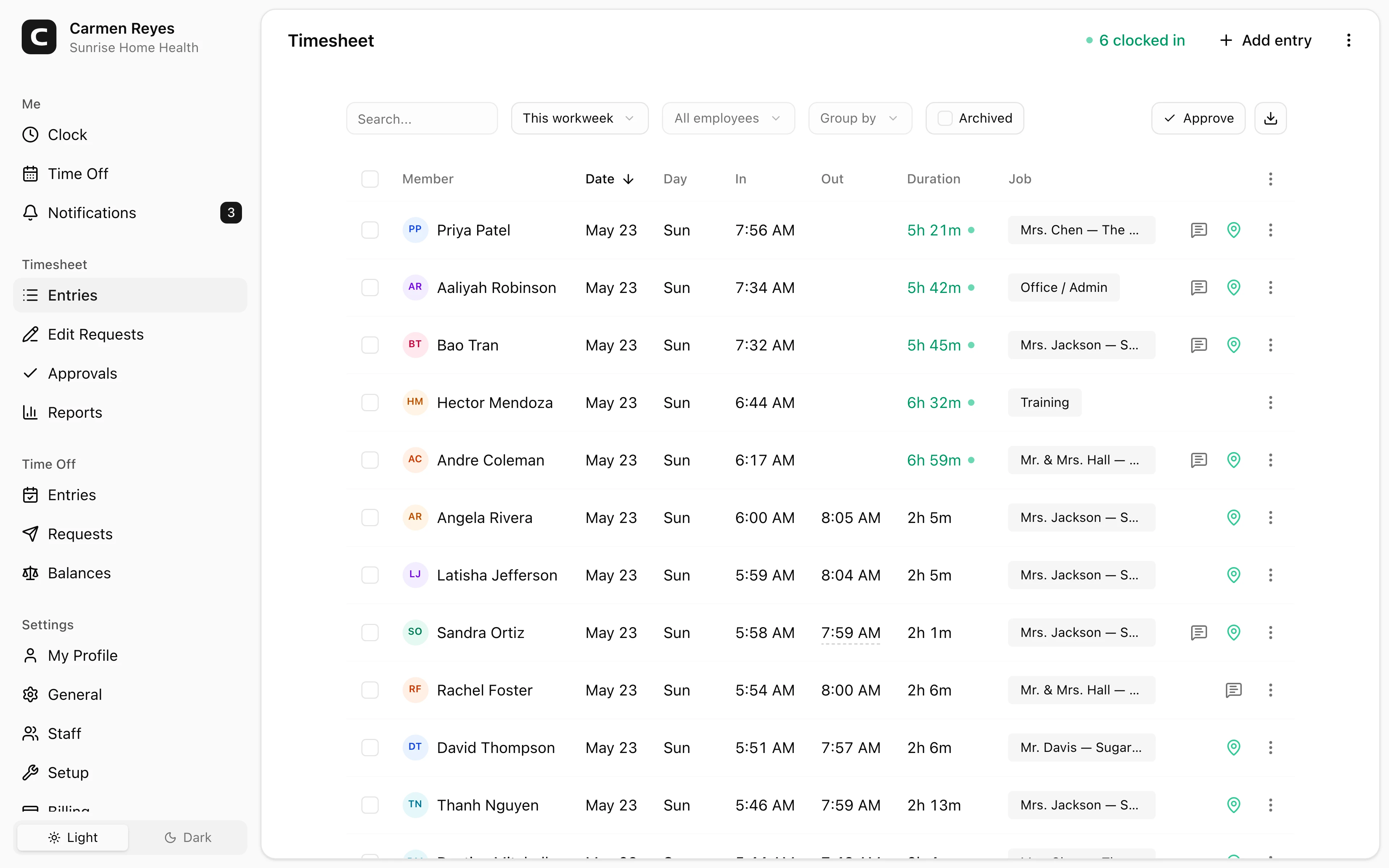
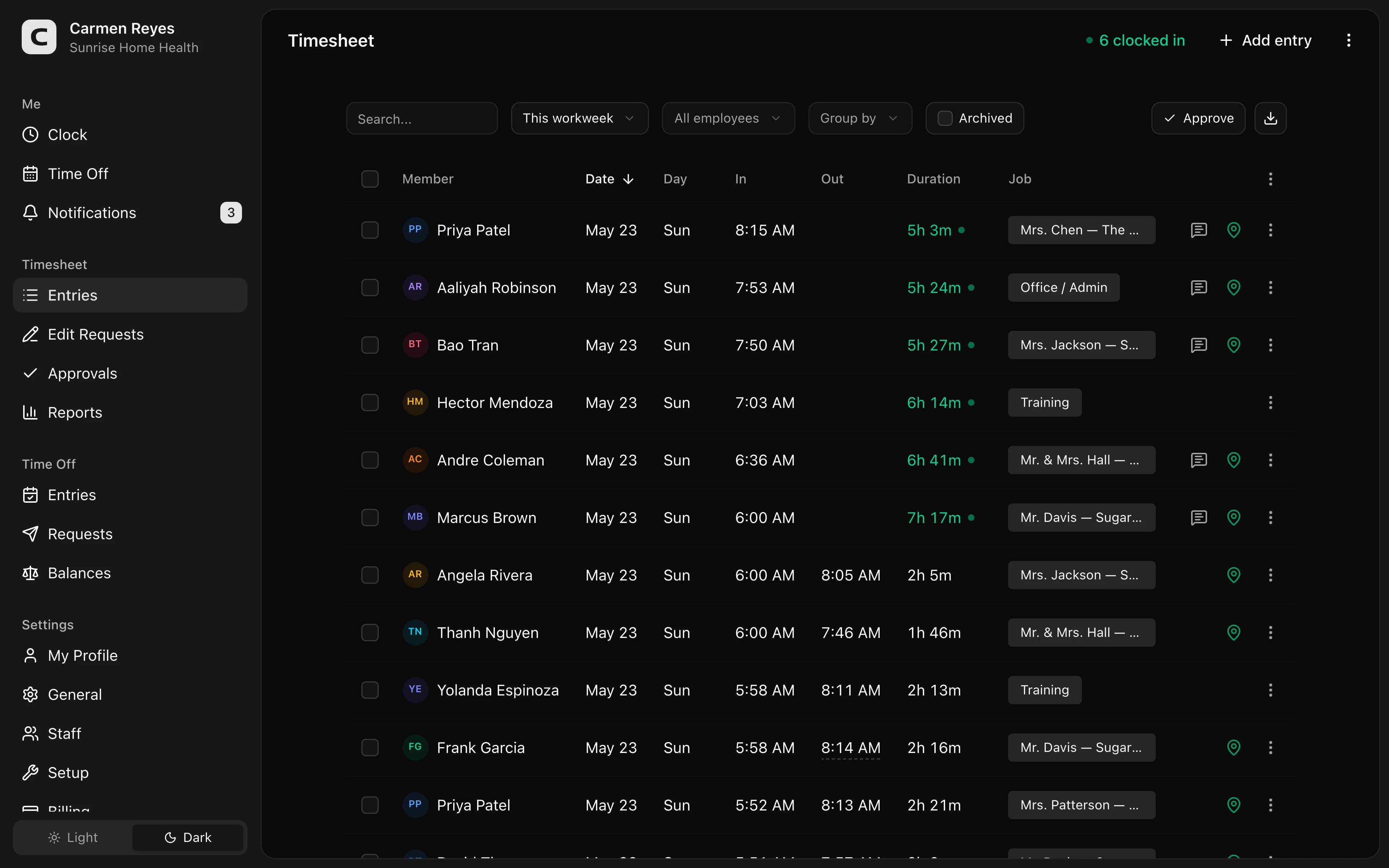 Open a no-login Clockspot demo with time entries, edits, approvals, and payroll-ready records.
Explain missed punches and edits
Every business has missed punches. The policy should say what happens next.
A good rule is simple:
- Employees report missed punches as soon as they notice them.
- Managers or authorized admins correct the time card.
- Every correction includes a reason.
- The original record stays visible.
- Repeated missed punches are handled as a policy issue, not by refusing to pay worked time.
For the detailed workflow, read how to handle missed punches before payroll.
Define approval
The policy should say who approves time cards and when.
For small teams, approval can be simple:
- Employees review their own time for obvious mistakes.
- Managers review exceptions and approve final time cards.
- Payroll exports approved hours.
- Late corrections after payroll close are documented separately.
Approval should happen before payroll, not after payroll. For the approval workflow, read how to approve employee time cards.
Include break tracking where it matters
If employees take unpaid meal breaks or work in states with strict break rules, the policy should say how breaks are recorded.
The policy does not need to explain every state law. It should tell employees what to do:
- Clock out for unpaid meal breaks.
- Clock back in when returning.
- Report missed, short, or interrupted breaks.
- Do not edit break records without a reason.
For state-by-state rules, read meal and rest break laws by state.
Keep records after payroll
The policy should say that time records remain available after payroll runs.
Payroll summaries are useful, but they are not the whole record. Keep the time cards, edits, approvals, schedules, and notes that explain the payroll total. For deeper retention rules, read recordkeeping requirements by state.
A simple policy outline
You can use this structure:
- Purpose: accurate payroll and reliable records.
- Who tracks time.
- When to clock in and out.
- Break recording.
- Missed punches and edits.
- Manager approval.
- Payroll close.
- Record retention.
- Repeated violations.
The policy should sound like instructions, not legal boilerplate.
A simple policy starter
Here is a starter you can adapt:
Hourly employees must record all working time each day. Clock in before starting work, clock out when work stops, and record unpaid meal breaks when required by our process. If you forget a punch or see a mistake, report it as soon as you notice it. A manager or authorized admin will correct the record with a reason. Time cards must be reviewed and approved before payroll. Time records, edits, approvals, and payroll summaries are kept after payroll runs.
This is not meant to replace legal review. It gives the business a simple operating rule employees and managers can actually follow.
Common mistakes
Writing a policy nobody can follow
If the policy is too long or vague, managers will ignore it during payroll.
Punishing missed punches through payroll
Coach repeated mistakes separately. Pay the worked time.
Forgetting managers
Employees need rules, but managers need rules too: what to review, when to approve, and what notes are required.
Treating payroll export as the end
Keep the records behind the payroll total after payroll runs.
FAQ
Does a small business need a written time tracking policy?
It is strongly recommended. A written policy gives employees, managers, and payroll the same rules before mistakes happen.
Should the policy say employees cannot work off the clock?
Yes, but it should also tell employees how to report time if work happens. A rule against off-the-clock work does not erase time that was actually worked.
Should missed punches be disciplined?
Repeated missed punches can be handled through coaching or discipline, but the time record should still be corrected so worked time is paid.
The bottom line
A good time tracking policy is not a handbook decoration. It is the weekly operating system for hourly payroll.
Tell employees when to record time, tell managers how to review it, and keep the records behind each paycheck.
Keep reading
How to Track Employee Hours for Payroll
Use this payroll-ready time tracking workflow to capture hours, review exceptions, approve edits, and keep records you can explain later.
How to Handle Missed Punches Before Payroll
Use this missed-punch workflow to correct time cards before payroll, keep an audit trail, and avoid paying from hours nobody can explain.
How to Approve Employee Time Cards Before Payroll
Use this time card approval workflow to review exceptions, confirm corrections, and send payroll hours you can explain later.
How to Prevent Buddy Punching Without Micromanaging
Reduce buddy punching with clear rules, manager review, location checks, edit trails, and a time tracking workflow employees can actually follow.
About Clockspot
Clockspot helps small businesses track employee time and keep payroll-ready records. Used in all 50 states since 2007, we focus on getting time and pay right — including the wage-and-hour rules that shape both.
Clockspot helps small businesses put time tracking rules into practice with clock-ins, edits, approvals, and payroll-ready records in one place. See how Clockspot supports employee time tracking.