How to Handle Missed Punches Before Payroll
Quick-read version · 1 minA missed punch is not unusual. An unexplained correction is the problem.
If an employee forgets to clock in or out, your job is not to punish the mistake or guess the cleanest number. Your job is to reconstruct the shift as accurately as you can, document why the correction was made, and approve the final time before payroll runs.
The missed-punch workflow
Handle every missed punch the same way, so the correction is not just a guess added before payroll:
- Find the missing punch before payroll closes.
- Confirm what time the employee actually started, stopped, or returned from break.
- Add the missing time as a correction, not as a silent replacement.
- Keep a short reason for the edit.
- Have a manager approve the correction.
- Include the corrected time in payroll only after the record is complete.
That is the difference between a normal payroll fix and a weak time record. A clean total is not enough. You need to know how the total was built.
Find missing punches early
The best time to fix a missing punch is the same day. The second-best time is before payroll closes.
Do not wait until payroll morning to look for incomplete time cards. By then, the employee may not remember the exact time, the manager may be approving from memory, and payroll may be under pressure to move the hours through.
Check for:
- A clock-in with no clock-out.
- A clock-out with no clock-in.
- A meal break with only one side recorded.
- A shift that is much longer or shorter than scheduled.
- A duplicate punch that looks like a correction attempt.
These are not just cleanup items. They can change pay, overtime, break records, and the confidence you have in the final payroll number.
The demo below shows where missed-punch cleanup becomes reviewable instead of informal. Look for the requested edit, the reason attached to it, and the approval step that keeps the final time card explainable.
No login required. Opens in one click.
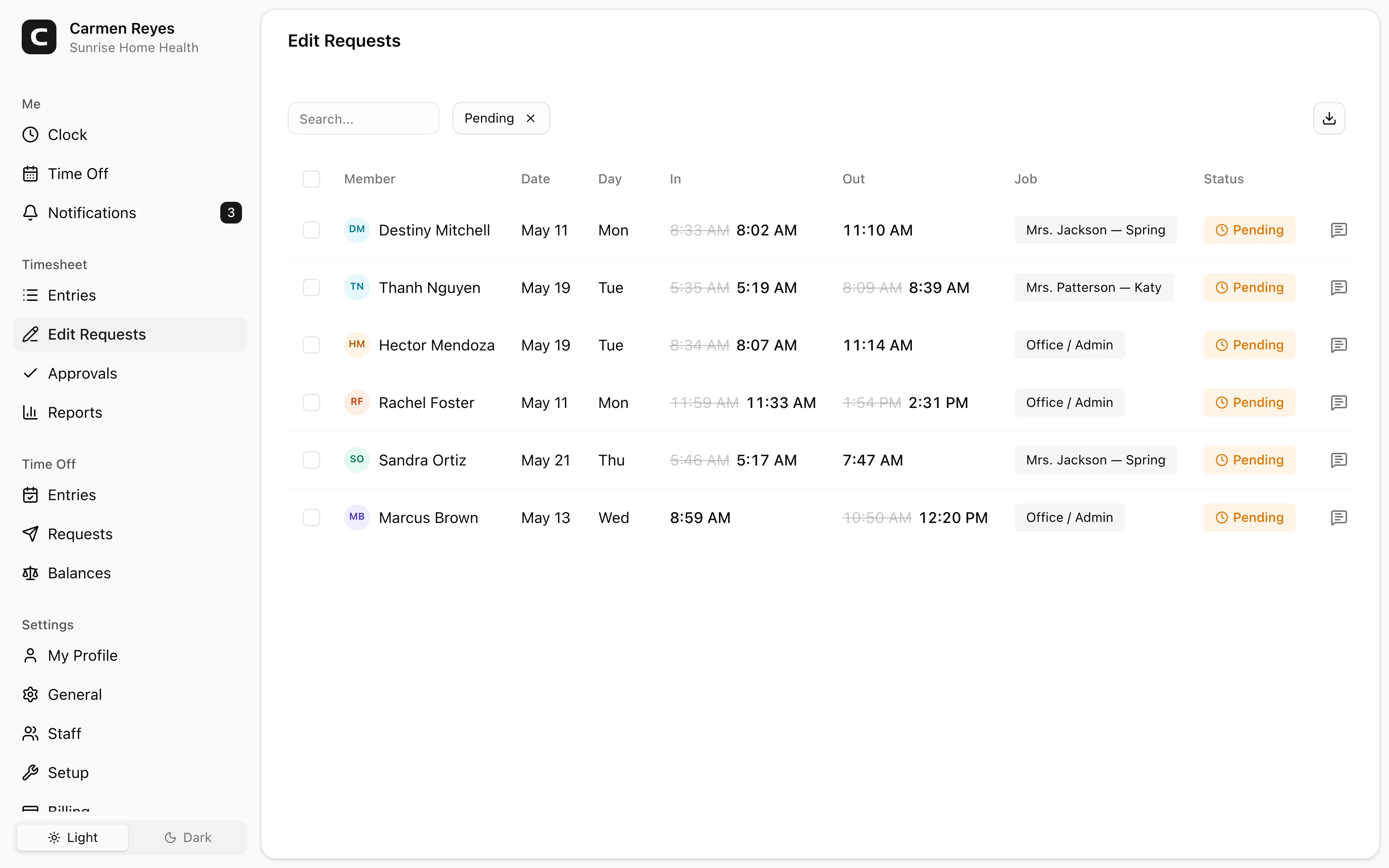
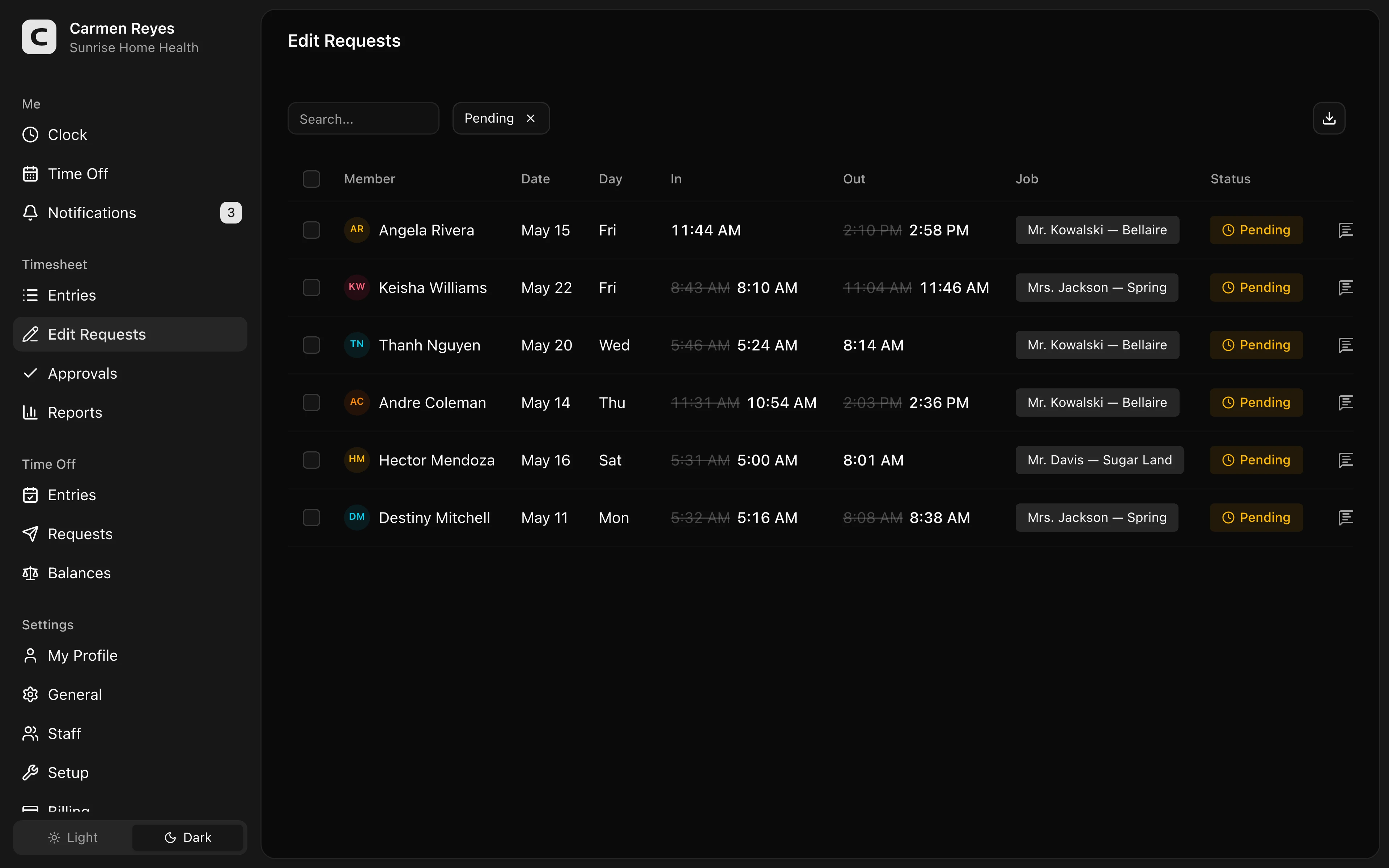 Open a no-login Clockspot demo with time entries, edits, approvals, and payroll-ready records.
Confirm the time before editing
Before anyone changes the time card, confirm the missing time from the best available information.
Start with the employee. Ask what happened and what time they actually started, stopped, or returned from break. Then compare that answer with the surrounding record:
- The posted schedule.
- Nearby clock events.
- Job or location records.
- Manager notes.
- Point-of-sale, dispatch, or appointment records, if they matter for the shift.
You are not looking for a perfect forensic investigation. You are trying to avoid a correction that is just a guess.
If the employee and manager disagree, do not hide the disagreement by entering a clean-looking number. Document the basis for the correction and keep the original record available.
Do not use missed punches as a pay penalty
A missed punch may violate your policy. It does not make worked time disappear.
If the employee worked, the time record should be corrected so payroll can pay the hours that were actually worked. Discipline, coaching, or repeated-mistake policies should be handled separately from the wage record.
That separation matters. If a time card is short because the employee forgot to clock out, payroll may look clean while the underlying record is wrong. The safer workflow is to correct the time, keep the note, and address the behavior through your normal employee process.
If you need to check how long wage and hour records must be kept, read recordkeeping requirements by state.
Keep the edit trail
Every missed-punch correction should answer four questions:
- What time was added or changed?
- Who made the correction?
- Why was the correction made?
- Who approved the final record?
Short notes are enough when they explain the change:
- Forgot to clock out after closing shift.
- Missed meal-break return punch.
- Clocked into wrong job.
- Duplicate punch removed.
- Manager confirmed shift ended at 5:12 PM.
Avoid notes that say only "fixed" or "adjusted." Those words tell you that something changed, but not why.
Approve the correction before payroll
Missed punches should not move straight from correction to payroll without review.
For a small business, the approval path can be simple:
- The employee reports or confirms the missed punch.
- The manager reviews the correction while the shift is still fresh.
- Payroll exports only approved hours.
- Late corrections are handled as adjustments, not quietly blended into a closed period.
This gives each person a clear role. The employee knows the record was corrected. The manager knows what changed. Payroll knows the final hours are ready.
For the larger payroll workflow, read how to track employee hours for payroll.
Watch the payroll risks
Missed punches often look small, but they can affect larger payroll questions.
Overtime
A missing clock-out can hide overtime. A missing clock-in can make overtime look higher than it was. Review the whole workweek before approving the correction, especially if the employee is near 40 hours or works in a state with daily overtime rules. For the legal rules, read US overtime rules by state.
Breaks
If the missing punch is tied to a meal break, the correction should show whether the break happened, when it happened, and whether it was short, late, or missed. Do not turn a break issue into a generic time edit with no explanation.
Rounding
Do not use rounding to bury a missed punch. If your business rounds time, the underlying correction still needs to be accurate and explainable. For the deeper rule, read time clock rounding rules.
Repeated missed punches
If one employee keeps missing punches, treat that as a management issue. If many employees keep missing punches, treat it as a workflow issue. The clock-in process may be confusing, managers may not be reviewing exceptions often enough, or employees may not know when they are expected to clock out.
A simple missed-punch policy
Your policy does not need to be long. It should answer five questions:
- When should an employee report a missed punch?
- Who can edit a time card?
- What note is required for the correction?
- Who approves the final time?
- What happens if the same employee keeps missing punches?
The policy should also make one point clear: employees must be paid for time actually worked, even when the time card needs a correction.
For a short policy managers and employees can follow, start here and adapt the review steps to your team.
If you need a printable correction request, use the missed punch correction form template or the broader timesheet correction form template.
Common mistakes
Letting payroll guess the time
Payroll may know the pay period, but payroll usually does not know what happened during the shift. Get the correction from the employee and manager before payroll exports the hours.
Replacing the original record
Do not erase the original punch pattern. Keep the original record, the corrected time, the reason, and the approver.
Waiting until the pay period closes
Late fixes are harder to verify. Review missed punches daily or midweek so the correction happens while the shift is still fresh.
Using discipline inside the time card
If an employee repeatedly forgets to clock out, address that as a policy issue. Do not reduce worked time as the punishment.
Treating every missed punch as fraud
Most missed punches are ordinary mistakes. Fraud is different: someone knowingly records time that was not worked or records time for someone else. If that is the concern, read the buddy punching guide.
FAQ
What should I do if an employee forgets to clock out?
Confirm when the employee actually stopped working, add the missing clock-out as a documented correction, keep the reason for the edit, and have a manager approve the final time before payroll.
Can I refuse to pay time because the employee forgot to clock in?
No. If the employee worked, the time record should be corrected so the employee is paid for the time worked. You can address repeated missed punches through your attendance or discipline process, but the wage record should still reflect the work.
Who should fix a missed punch?
Give this job to a manager, payroll admin, or timekeeper with permission to edit time cards. The employee should report or confirm the mistake, but the business should control the final correction and approval.
Do employees need to sign off on missed-punch corrections?
Federal law does not require one universal signoff form, but employee confirmation is useful. It makes the correction easier to explain later if the employee questions the paycheck.
Should I keep the original punch after fixing it?
Yes. Keep the original record and the corrected record. The correction is stronger when it shows what changed, who changed it, when it changed, and why.
The bottom line
A missed punch is fixable. A missing explanation is what creates payroll risk.
Correct the time, keep the reason, approve the change before payroll, and preserve the record behind the paycheck.
Keep reading
How to Track Employee Hours for Payroll
Use this payroll-ready time tracking workflow to capture hours, review exceptions, approve edits, and keep records you can explain later.
How to Approve Employee Time Cards Before Payroll
Use this time card approval workflow to review exceptions, confirm corrections, and send payroll hours you can explain later.
How to Close a Pay Period for Hourly Employees
Use this pay-period close workflow to review time cards, resolve exceptions, approve hours, export payroll, and keep records after payroll runs.
How to Write an Employee Time Tracking Policy
Create a simple employee time tracking policy that tells workers when to clock in, how to report mistakes, who approves time, and what records the business keeps.
About Clockspot
Clockspot helps small businesses track employee time and keep payroll-ready records. Used in all 50 states since 2007, we focus on getting time and pay right — including the wage-and-hour rules that shape both.
Clockspot helps small businesses keep missed-punch edits, reasons, approvals, and payroll-ready time records in one place. See how Clockspot handles time card corrections.