Time Card Audit Trail: What Small Businesses Should Keep
A time card audit trail is the story behind the payroll total.
If payroll says an employee worked 38.75 hours, the business should be able to see how that number was built: the punches, edits, reasons, approvals, and any late corrections. Without that trail, payroll may be paid correctly but still be hard to explain.
What the audit trail should show
A useful time card audit trail shows:
- Original clock-ins and clock-outs.
- Manual edits.
- The reason for each edit.
- Who made the edit.
- When the edit happened.
- Manager approval.
- Late corrections after payroll closes.
- The payroll total or export connected to the time record.
The point is not to bury managers in detail. The point is to keep the record explainable.
Keep the original record visible
When a manager fixes a missed punch, the corrected time matters for payroll. But the original problem still matters for the record.
A good audit trail should show that the punch was missing, who corrected it, why it was corrected, and when the correction happened. That prevents a corrected time card from looking like it was never changed.
For missed-punch workflow, read how to handle missed punches before payroll.
The demo below shows the edit-request side of that audit trail. Look for the original problem, the requested correction, the reason, and the review step that keeps a changed time card from becoming unexplained.
No login required. Opens in one click.
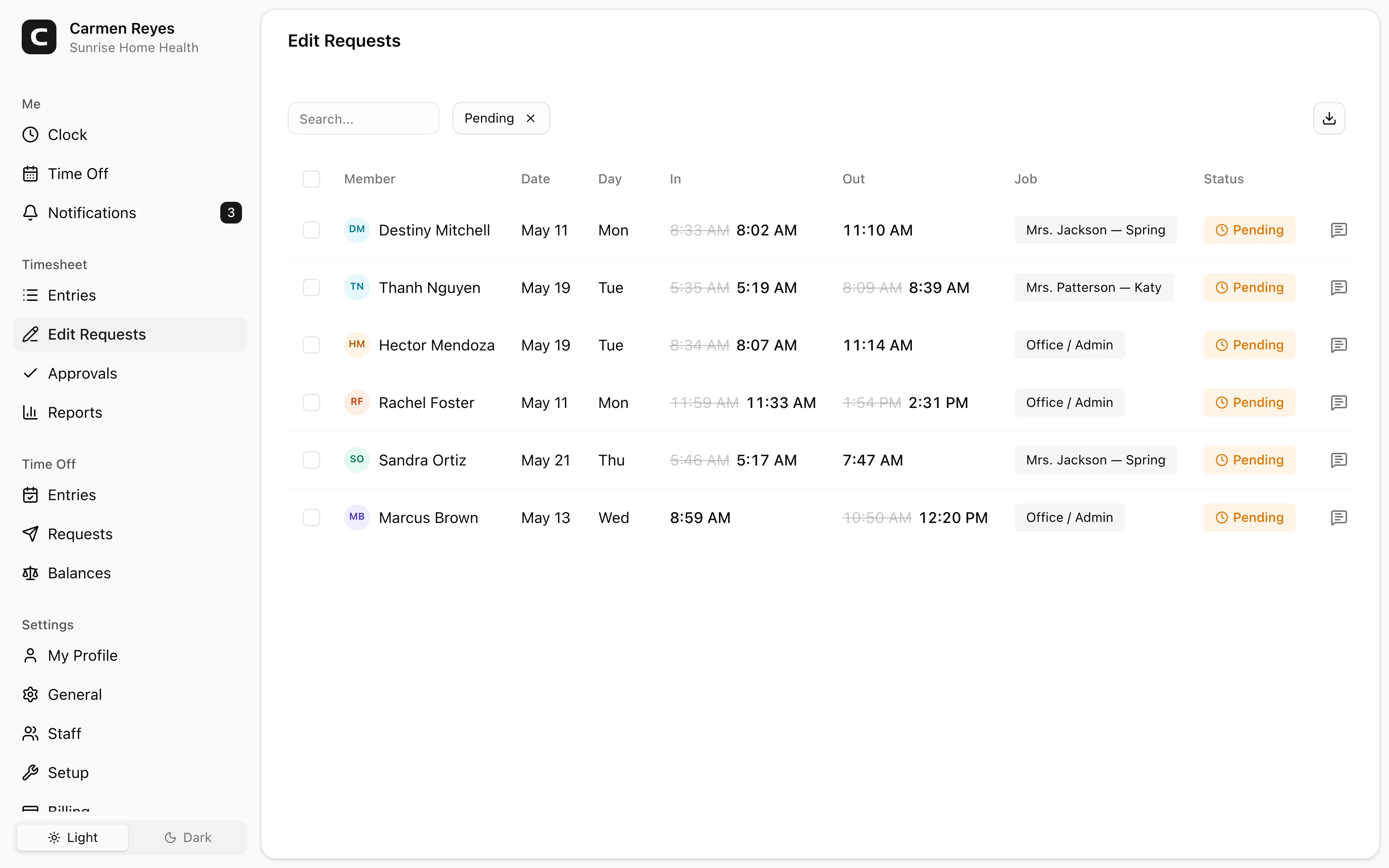
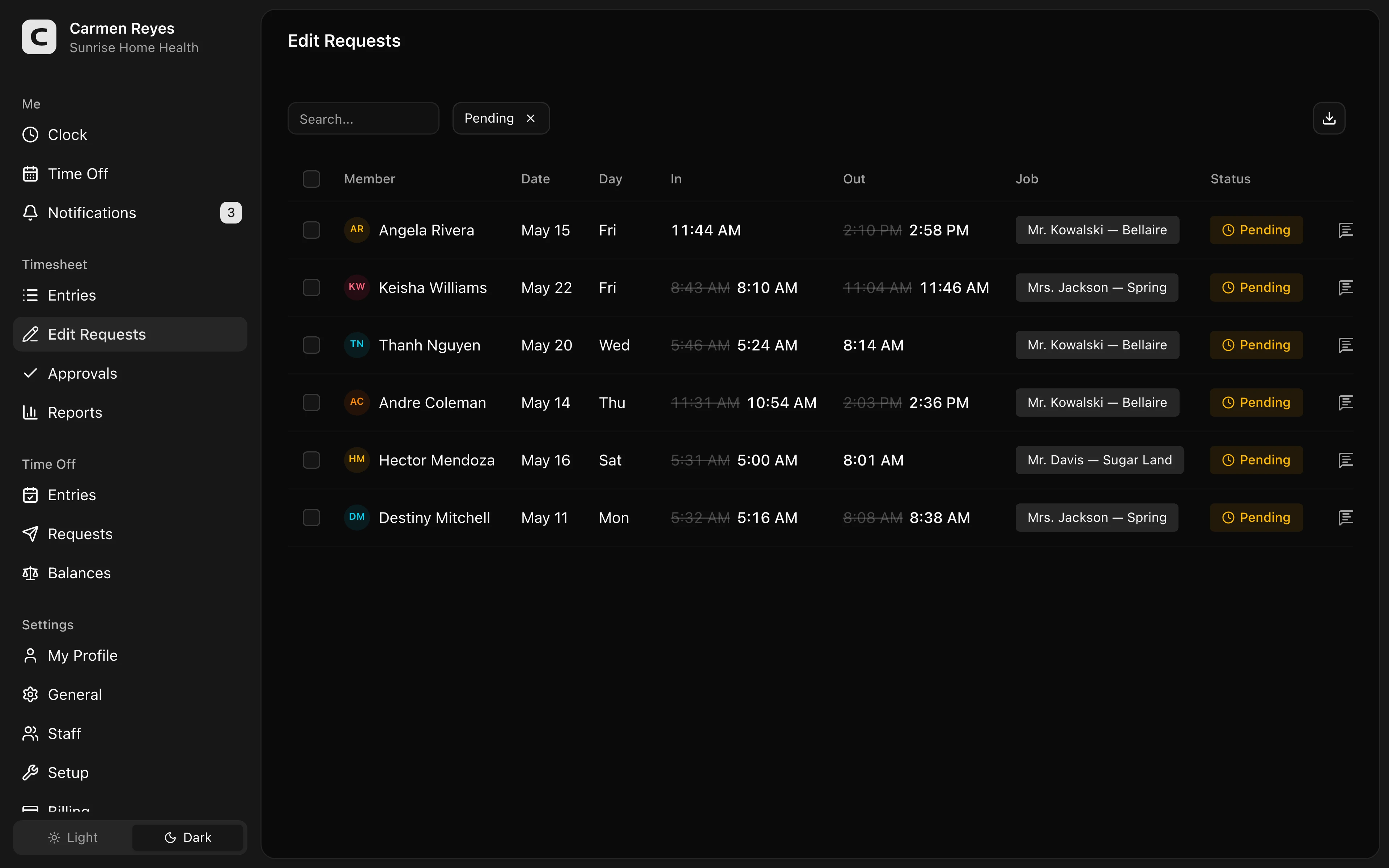 Open a no-login Clockspot demo with time entries, edits, approvals, and payroll-ready records.
Attach reasons to edits
An edit without a reason creates a second question.
Useful reasons are simple:
- Employee forgot to clock out.
- Manager corrected job code.
- Employee worked at a different location.
- Break was interrupted.
- Payroll correction after late report.
The reason does not need to be a legal memo. It needs to explain the business record.
Approval is part of the trail
Approval should show who accepted the final time card for payroll.
That matters because a time card can have many small events: punches, breaks, edits, job changes, location changes, and notes. Approval is the handoff that says the record is ready for payroll.
For the approval workflow, read how to approve employee time cards.
Late corrections should not disappear
Sometimes a mistake is found after payroll closes.
Fix the mistake, but keep the correction visible. The record should show the earlier approved time, the later correction, the reason, and the payroll adjustment path. Quietly reopening a closed period and changing the old record creates confusion later.
For the close workflow, read how to close a pay period for hourly employees.
What this does not replace
An audit trail is not a substitute for knowing the law.
Federal and state recordkeeping rules can require specific payroll and time records for specific periods. The audit trail is the operational layer that makes those records easier to explain.
If you need to check how long payroll records must be kept, read recordkeeping requirements by state.
Common mistakes
Keeping only the payroll export
Payroll export is the output. The audit trail is the record behind it.
Letting edits overwrite the past
Corrections should correct the record, not erase how the record changed.
Approving before exceptions are fixed
Approval should mean the time card is ready for payroll.
Writing vague edit reasons
"Fixed" is not a useful reason. Say what changed.
FAQ
What is a time card audit trail?
It is the record that shows how a time card changed over time: punches, edits, reasons, approvals, corrections, and payroll handoff.
Do small businesses need an audit trail?
They need records they can explain. An audit trail helps managers, payroll, owners, and advisors understand how the payroll total was created.
Is a payroll report enough?
Usually not by itself. A payroll report shows the result. The business should also be able to see the time records that produced the result.
The bottom line
A good audit trail makes time cards explainable.
Keep the original punches, edits, reasons, approvals, and late corrections connected so payroll totals do not become numbers nobody can reconstruct.
Keep reading
How to Track Employee Hours for Payroll
Use this payroll-ready time tracking workflow to capture hours, review exceptions, approve edits, and keep records you can explain later.
How to Handle Missed Punches Before Payroll
Use this missed-punch workflow to correct time cards before payroll, keep an audit trail, and avoid paying from hours nobody can explain.
How to Approve Employee Time Cards Before Payroll
Use this time card approval workflow to review exceptions, confirm corrections, and send payroll hours you can explain later.
How to Close a Pay Period for Hourly Employees
Use this pay-period close workflow to review time cards, resolve exceptions, approve hours, export payroll, and keep records after payroll runs.
About Clockspot
Clockspot helps small businesses track employee time and keep payroll-ready records. Used in all 50 states since 2007, we focus on getting time and pay right — including the wage-and-hour rules that shape both.
Clockspot helps small businesses keep time cards, edits, reasons, approvals, and payroll-ready records connected. See how Clockspot keeps time card records connected.