Time Clock App for Construction: What Small Crews Should Look For
A construction time clock has to work where the crew works.
If employees move between job sites, start before the office opens, or split time across jobs, paper time cards and end-of-week memory can break down fast. The right app should make crew hours easier to review, approve, and keep ready for payroll.
Start with the job-site workflow
A construction time clock should support the basic field workflow:
- Crew members clock in from the phone or job site.
- Each time entry is assigned to the right job, location, or cost code.
- A crew lead, foreman, or manager reviews exceptions.
- Any time-card edits include the reason for the change.
- Time cards are approved before payroll.
- Approved hours are ready before payroll.
- Job-time records stay available after the job and pay period close.
That workflow matters more than a long feature list.
GPS is useful, but not the whole system
GPS can help show where a clock-in happened. It can also help a manager spot time assigned to the wrong job site.
But GPS is not the whole record. The business still needs:
- The employee.
- The clock-in and clock-out.
- The job or location.
- Any time-card corrections and the reasons behind them.
- Manager approval.
- Payroll export or summary.
- A record that can be found later.
For GPS-specific buying advice, read employee time clock with GPS.
The job-costing demo below shows how job or location time can stay connected after crews submit hours. Use it to see whether the office could review labor by project before payroll or billing questions come up.
No login required. Opens in one click.
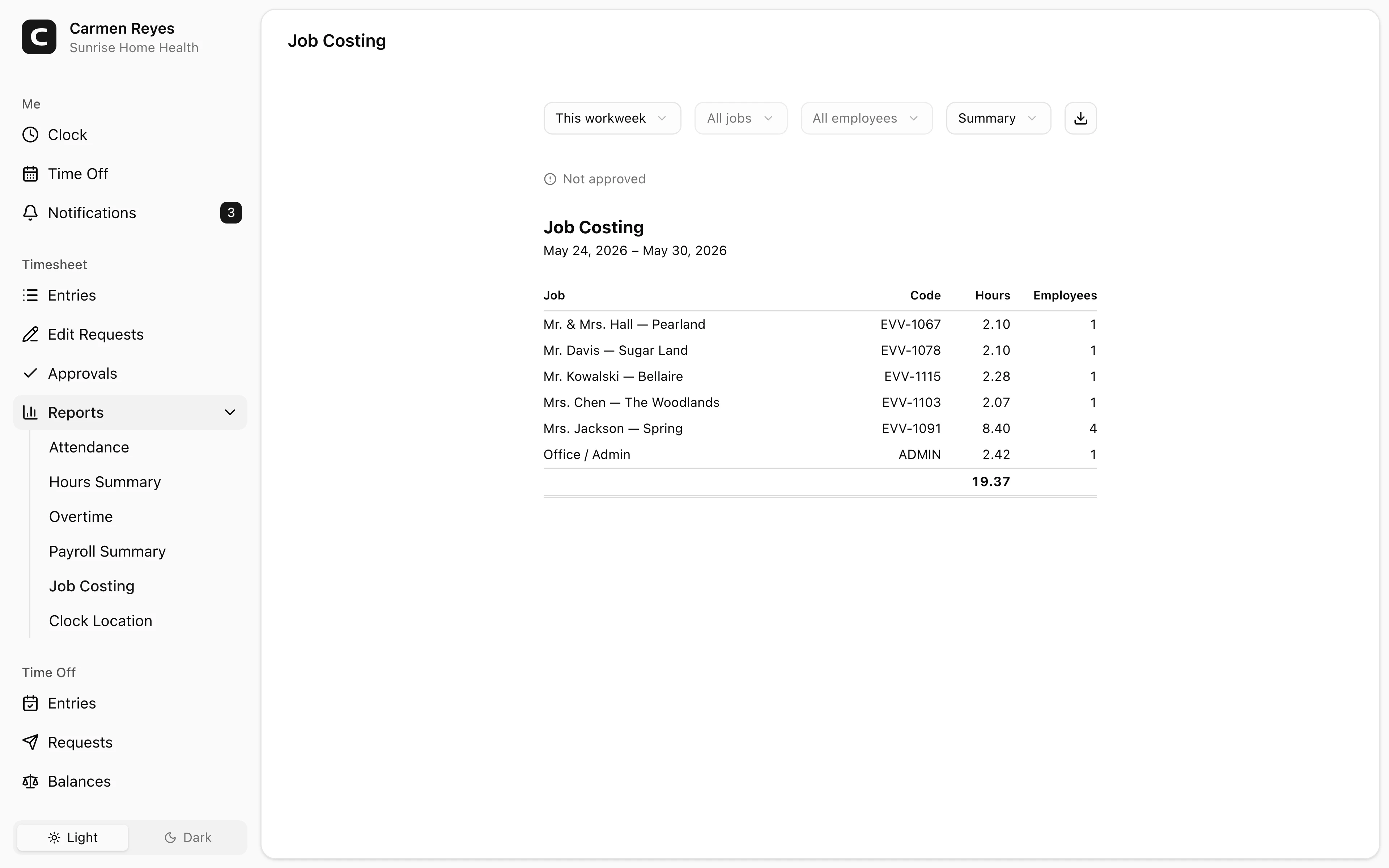
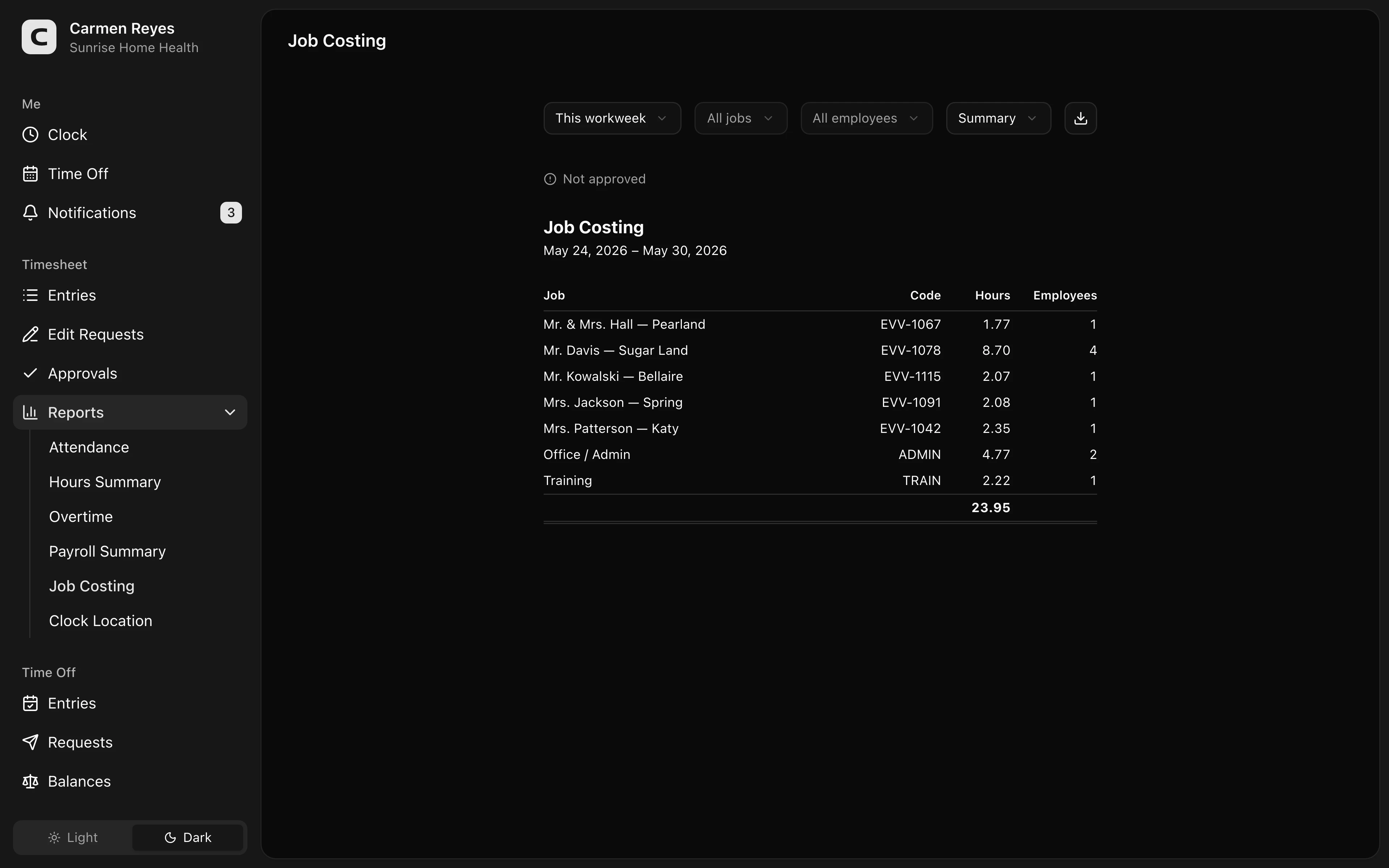 Open a no-login Clockspot demo with time entries, edits, approvals, and payroll-ready records.
Job costing needs clean time records
Construction teams often need hours by job, customer, phase, location, or cost code.
That does not mean every crew needs a complex job-costing system. It means the time clock should capture the detail that actually matters to the business. If labor hours are split across three jobs, the record should show that split before payroll and job reports use it.
If job sites affect payroll or job costing, read how to track employee hours by job or location.
Watch for travel and drive-time questions
Construction and field teams often have travel between job sites, shop time, material pickup, and changing start locations.
The time clock app will not answer every legal question by itself. But it should make the record easier to review:
- Where did the day start?
- Which job did the employee work on?
- Did the employee move between jobs?
- Was travel time recorded separately when needed?
- Did the manager approve the final split?
For the pay rules behind travel and mileage, read travel time pay and mileage reimbursement requirements by state.
Make it simple enough for the crew
If the app is too complicated, the record gets worse.
Field employees should not need to fight the software just to start work. Keep the required fields limited to the information managers actually use: job, location, maybe task or cost code. Too many options create random selections and cleanup later.
When Clockspot is a good fit
Clockspot is a good fit when a small construction or field-service business needs focused time tracking, not full construction project management:
- Crew members clock in and out.
- Hours can be reviewed with job, location, or cost-code context.
- Managers review missed punches, corrections, and approvals.
- Approved hours are ready before payroll.
- The business can find the record later.
It may be a poor fit if the business needs full construction project management, dispatch, equipment tracking, daily field reports, bid management, or certified payroll built into the same system.
If that matches your crew's workflow, open the job-costing demo above, then check Clockspot pricing or start a free trial.
Questions to ask before choosing
Ask:
- Can crews clock in quickly from the field?
- Can time be assigned to the right job or location?
- Can managers review GPS or location exceptions without micromanaging?
- Can job-time splits be approved before payroll?
- Can payroll export approved hours?
- Can old time records be searched by employee, date, job, or location?
- Is the app easier than the paper or spreadsheet process it replaces?
FAQ
What is the best time clock app for construction?
The best app is the one that fits the crew's workflow: mobile clock-in, job or location tracking, exception review, manager approval, payroll export, and searchable records.
Does construction time tracking need GPS?
Often, but not always. GPS helps when crews work away from a fixed workplace or when job-site location affects approval, job costing, or payroll review.
Should construction crews track time by job?
Yes, when job detail affects payroll, job costing, billing, or manager approval. If the business never uses the detail, do not add friction.
The bottom line
A construction time clock should make field hours easier to trust.
Choose the app that helps crews record time quickly, helps managers approve the right job and location, and leaves a clear time record behind each paycheck.
Keep reading
How to Track Employee Hours for Payroll
Use this payroll-ready time tracking workflow to capture hours, review exceptions, approve edits, and keep records you can explain later.
How to Track Employee Hours by Job or Location
Track employee hours by job or location so payroll, job costing, overtime review, and manager approval all use the right time record.
Employee Time Clock With GPS: When Small Businesses Need It
Use GPS time tracking when location affects payroll, job costing, field work, approvals, or trust. Here is what to look for before choosing a GPS time clock.
How to Handle Missed Punches Before Payroll
Use this missed-punch workflow to correct time cards before payroll, keep an audit trail, and avoid paying from hours nobody can explain.
About Clockspot
Clockspot helps small businesses track employee time and keep payroll-ready records. Used in all 50 states since 2007, we focus on getting time and pay right — including the wage-and-hour rules that shape both.
Clockspot helps field teams keep employee hours, job/location context, corrections, approvals, and payroll-ready records connected. See how Clockspot supports construction time tracking.