How to Prevent Buddy Punching Without Micromanaging
Buddy punching is a real problem, but heavy-handed controls can create a bigger one.
The goal is to make dishonest time entries harder while keeping the normal clock-in process simple for honest employees. You need clear rules, visible records, manager review, and a fair way to handle mistakes.
Start with a clear rule
The policy should be simple:
- Employees clock in and out only for themselves.
- Employees record time when the work happens.
- Employees report missed punches instead of asking someone else to clock them in.
- Managers review exceptions before payroll.
- Falsifying time records can lead to discipline.
Put the rule in the time tracking policy and explain it during onboarding.
This prevention work belongs inside the broader payroll-ready time tracking workflow, where clock-ins, edits, approvals, and final payroll records stay connected.
Make the honest path easy
Employees are more likely to follow the rule when clocking in is easy.
If the process is confusing, slow, or unavailable where work starts, employees may create workarounds. Some workarounds are innocent. Some become fraud. Either way, the record gets weaker.
For the broader policy framework, read employee time tracking policy.
The demo below shows a reviewable location-activity report, which is the kind of lower-friction proof to check before jumping to heavier identity tools. Look for patterns a manager can review without turning every clock-in into surveillance.
No login required. Opens in one click.
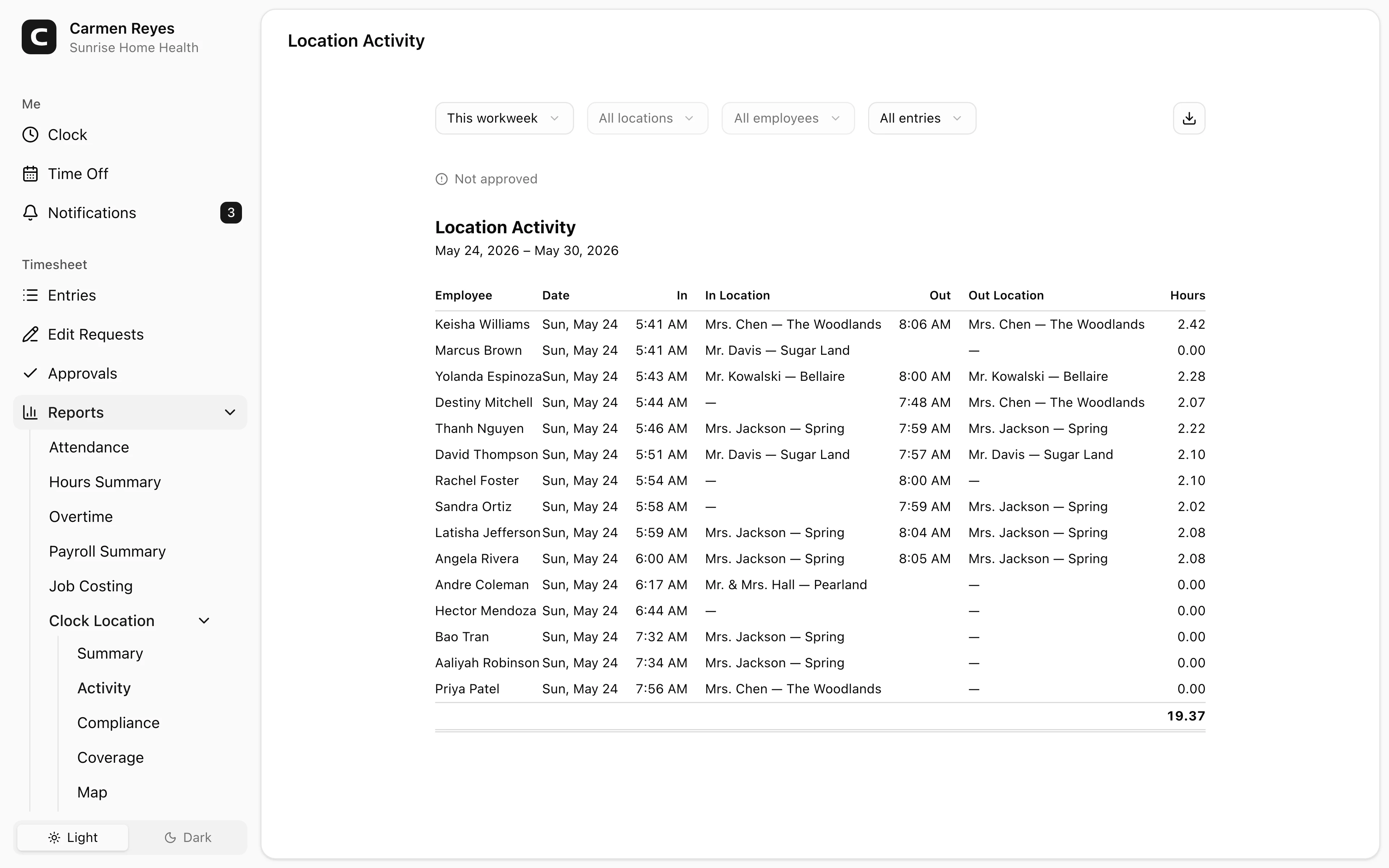
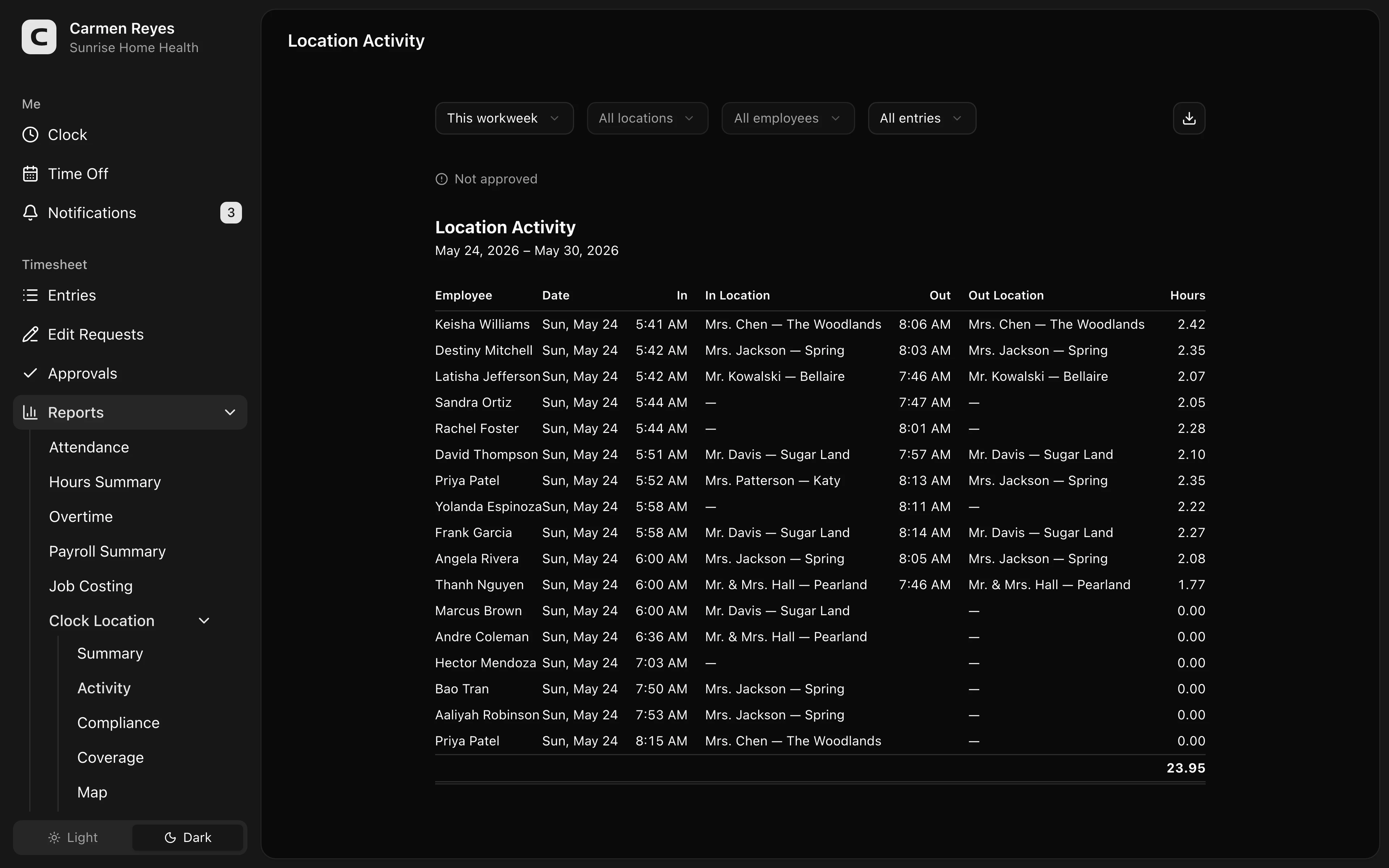 Open a no-login Clockspot demo with time entries, edits, approvals, and payroll-ready records.
Review the right signals
You do not need to spy on every punch. Review the signals that actually matter:
- Same device or location used for multiple employees.
- Clock-ins far from the expected job site.
- Punches that do not match the schedule.
- Repeated missed punches followed by manager edits.
- Employees clocking in before they normally arrive.
- Time records changed after approval.
These are review prompts, not automatic proof. A manager should look at the context before taking action.
Use location carefully
Location data can help confirm whether a punch matches the expected work site.
Use it as a payroll-control signal, not as a substitute for judgment. A location mismatch could mean fraud, but it could also mean the employee started at a different site, had bad signal, or was assigned somewhere else.
The best workflow is to flag the mismatch, ask what happened, correct the record if needed, and keep the explanation.
Keep an edit trail
Buddy punching investigations often depend on whether the business can explain the record.
Keep:
- Original clock events.
- Manual edits.
- Edit reasons.
- Manager approvals.
- Job or location context.
- Post-approval changes.
Do not let managers overwrite suspicious records with clean-looking totals. Preserve the path from original punch to final payroll number.
For the deeper legal and fraud-focused guide, read buddy punching and time clock fraud.
Handle mistakes differently from fraud
Not every bad punch is buddy punching.
An employee may forget to clock out, choose the wrong job, or clock in from the parking lot before walking inside. Those issues still need correction, but they are different from knowingly recording time for someone else.
Treat ordinary mistakes through coaching and correction. Treat intentional falsification through your discipline process.
For missed punches, read how to handle missed punches before payroll.
Common mistakes
Making the clock-in process too hard
If clocking in is frustrating, employees find workarounds.
Treating every exception as fraud
Exceptions need review. They are not automatic proof.
Ignoring manager approval
Managers are often the best people to spot whether a punch makes sense.
Deleting the original record
Keep the original punch and the correction trail.
Using surveillance language with employees
Clear rules work better than making honest employees feel accused.
FAQ
What is buddy punching?
Buddy punching happens when one employee records time for another employee, usually by clocking them in or out when they are not actually working.
How can a small business prevent buddy punching?
Use clear rules, easy clock-in, location or device review where appropriate, manager approval, and edit trails that preserve the original time record.
Is every missed punch buddy punching?
No. Most missed punches are ordinary mistakes. Review the record before deciding whether the issue is fraud, error, or a workflow problem.
The bottom line
Preventing buddy punching is not about making the workplace suspicious.
Make honest clock-in easy, make suspicious records visible, review exceptions before payroll, and keep the record behind each paycheck.
Keep reading
How to Track Employee Hours for Payroll
Use this payroll-ready time tracking workflow to capture hours, review exceptions, approve edits, and keep records you can explain later.
How to Handle Missed Punches Before Payroll
Use this missed-punch workflow to correct time cards before payroll, keep an audit trail, and avoid paying from hours nobody can explain.
How to Write an Employee Time Tracking Policy
Create a simple employee time tracking policy that tells workers when to clock in, how to report mistakes, who approves time, and what records the business keeps.
Employee Time Clock With GPS: When Small Businesses Need It
Use GPS time tracking when location affects payroll, job costing, field work, approvals, or trust. Here is what to look for before choosing a GPS time clock.
About Clockspot
Clockspot helps small businesses track employee time and keep payroll-ready records. Used in all 50 states since 2007, we focus on getting time and pay right — including the wage-and-hour rules that shape both.
Clockspot helps small businesses keep time entries, locations, edits, approvals, and payroll-ready records connected. See how Clockspot supports accurate time records.